
Geometric Tolerances: Orientation — Angularity
Angularity is an orientation tolerance that defines how accurately a feature—such as a surface, edge, or axis—must be positioned at a specified angle relative to a datum surface or axis. Unlike perpendicularity (90°) and parallelism (0°), angularity can use any angle specified by the designer. Angularity is one of the orientation tolerances defined in the ISO 1101 standard.
The tolerance zone is formed between two boundary surfaces corresponding to the specified angle. All points of the feature being inspected must lie between these surfaces. For an axis, the tolerance zone forms a wedge-shaped area oriented at the specified angle relative to the datum.
Applications
- Chamfers and inclined surfaces: ensures that a chamfer remains at the designed angle, for example, to support assembly or strength requirements.
- Machined grooves and guide surfaces: angularity ensures that grooves and guides are correctly positioned relative to one another.
- Angled joints: for example, when a part must be installed at a specific angle and small deviations must not impair its function.
Specification and Interpretation
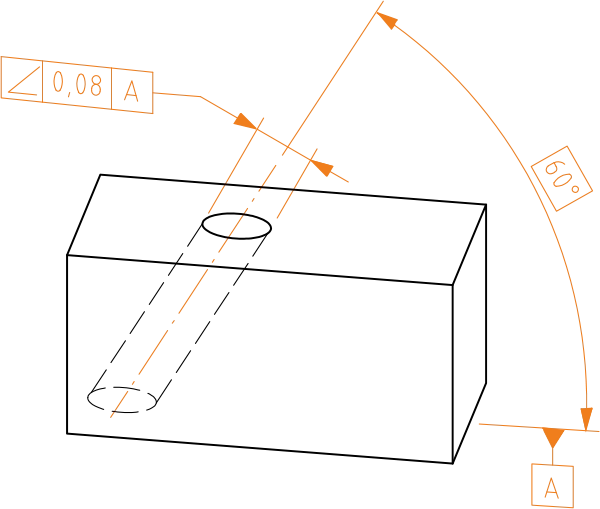
The measured (actual) centerline must lie between two parallel planes that are 0.08 units apart and oriented at 60° (a theoretically exact dimension) to datum plane A.
Definition of the Tolerance Zone
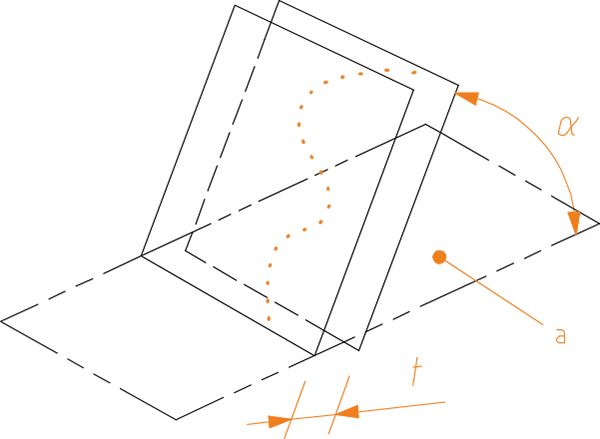
The tolerance zone is bounded by two parallel planes that are t units apart and oriented at the specified angle relative to the datum line.
Importance in Manufacturing
Angularity is an important tolerance, particularly for parts where maintaining the precise angle affects assembly, sealing, or load distribution. If the angle deviates too much, the parts may not fit together, the load may be directed incorrectly, or movement may not be smooth. On the other hand, excessively tight angularity requirements increase manufacturing costs because they require highly precise machining and inspection.
An angularity tolerance gives the designer flexibility to control the accuracy of angles: precisely enough to ensure proper function, but without unnecessary overprecision in manufacturing.


