
Geometric Tolerances: Direction — Perpendicularity
Perpendicularity is an orientation tolerance that defines how accurately a feature—for example, a surface, edge, or axis—must be located at a 90° angle relative to a reference surface or axis. It does not measure the feature’s location, but rather its angular deviation from ideal perpendicularity. Perpendicularity is one of the orientation tolerances defined in the ISO 1101 standard.
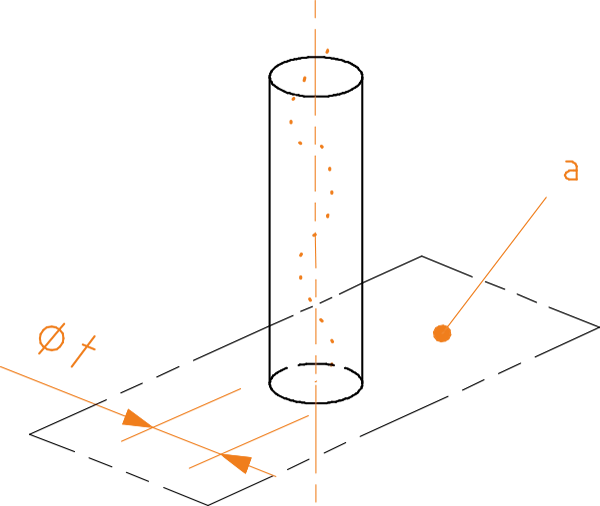
The tolerance zone is formed so that the measured feature must remain within a specified tolerance value relative to the datum. For a surface, the tolerance zone consists of two planes perpendicular to the datum, between which the surface must fit. For an axis, the zone is cylindrical, with its axis perpendicular to the selected datum.
Applications
- Holes and pins: ensuring that a hole is drilled at exactly 90° to another surface so that a pin or bolt fits correctly.
- Machine joining surfaces: for example, frame surfaces that must be exactly perpendicular to ensure even load distribution.
- Guideways and guiding surfaces: preventing sticking and uneven wear when the movement of the parts depends on precise angular alignment.
Notation and interpretation
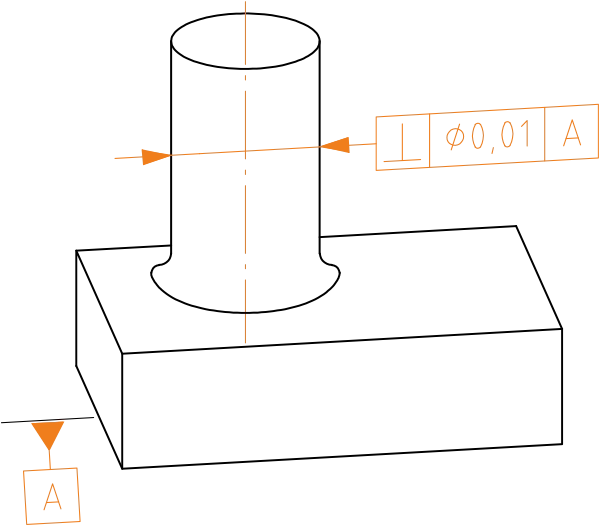
The measured (actual) median line of the cylinder must lie within a cylinder with a diameter of 0.01 that is perpendicular to datum A.
Definition of the tolerance zone
If the symbol , is indicated before the tolerance, the tolerance zone is bounded by a cylinder with a diameter of t that is perpendicular to the datum feature.
Significance in manufacturing
Perpendicularity is a highly important functional tolerance, since even a small angular deviation can cause clearance, stress, or malfunctions at joints. For example, if a bearing housing is not perpendicular to the shaft, uneven loading and rapid wear may result.
On the other hand, an excessively strict perpendicularity requirement significantly increases manufacturing costs, because achieving the required accuracy calls for precision machining and inspection. Design must therefore strike a balance between practical functionality and manufacturing cost-effectiveness.


