
Geometric Tolerances: Form — Circularity
Circularity (also called roundness) is a form tolerance that defines how accurately a circular cross-section follows an ideal circle. It limits deviations such as ovality, eccentricity, and waviness, ensuring that the cross-section of the part remains within the specified tolerance zone. Circularity is one of the basic form tolerances defined in the ISO 1101 standard.
The tolerance zone lies between two concentric circles whose radial separation corresponds to the tolerance specified on the drawing. All points of the measured feature must lie between these circles. Unlike many other tolerances, circularity does not reference a datum; it applies to the form of the feature itself.
Applications
- Shafts and holes: ensuring that shafts fit into bearings without excessive clearance or point loading.
- Sealing surfaces: ensuring a uniform shape to prevent leakage and wear.
- Rotating components: sufficient circularity reduces vibration and imbalance in machinery.
Indication and Interpretation
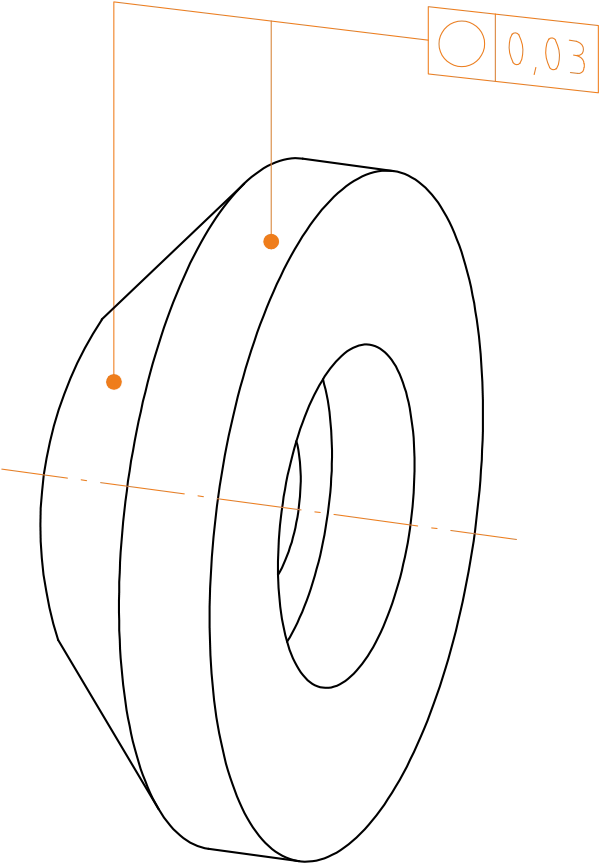
The measured (actual) circumference of every cross-section of both a cylindrical and a conical surface must lie between two concentric circles in the same plane, whose radial separation is 0.03.
Definition of the Tolerance Zone
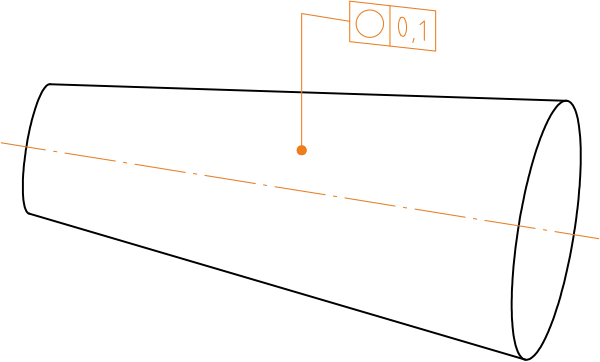
The measured (actual) circumference of every intersection between the surface of revolution and the intersecting cone (whose axis is the axis of the fitted surface of revolution and whose generatrix is perpendicular to the normal of the surface of revolution) must lie within the conical zone of the intersecting cone bounded by two circles whose separation is 0.1 (this separation is measured along the generatrix).
Importance in Manufacturing
Circularity is a key factor in precision engineering. If a shaft or hole is not sufficiently round, it can result in uneven loading, noise, vibration, or premature wear. On the other hand, an excessively tight circularity requirement increases manufacturing costs, as achieving and measuring it requires specialized methods and a high degree of precision.


