
Geometric Tolerances: Position (True Position)
Position is a location tolerance used to define the location of a feature—such as a hole, shaft, groove, or pin—in relation to other features or datums. It is one of the most widely used geometric tolerances because it enables, for example, the precise positioning of holes and ensures that parts fit together as intended.
Position tolerance controls three things simultaneously: location, orientation, and form. It defines the permissible deviation of a feature’s centerline or center point from its theoretically exact location. The tolerance zone is typically a cylinder or rectangular area within which the measured feature’s actual center point or axis must lie.
Applications
- Holes and bolt patterns: ensuring that the holes are located correctly in relation to one another and to the mounting surface.
- Shafts and pins: precise location ensures that rotating parts and connections function as intended.
- Machine-part joints: position tolerance prevents clearance or stress at connection points caused by incorrect positioning of the parts.
Indication and Interpretation
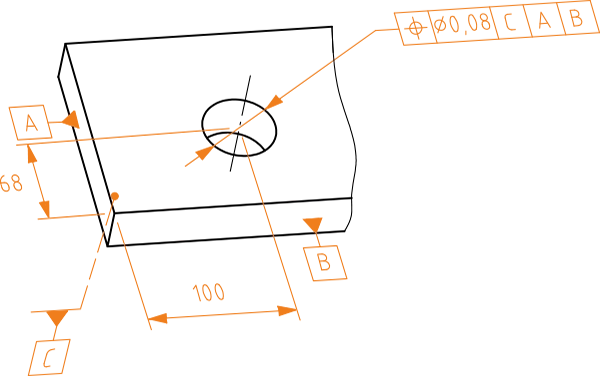
The measured (actual) centerline must lie within a cylindrical zone with a diameter of 0.08. The axis of the zone coincides with the theoretically exact location of the hole, taking datums C, A, and B into account.
Definition of the Tolerance Zone
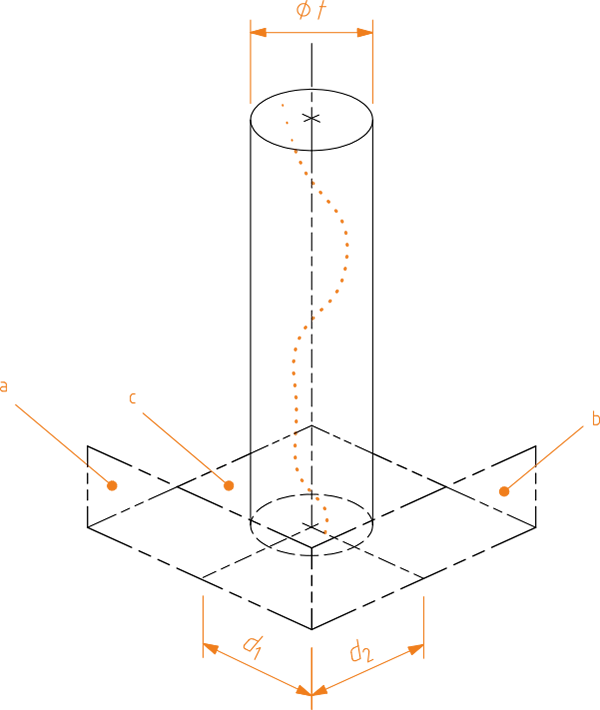
If the symbol is indicated before the tolerance, the tolerance zone is bounded by a cylinder with a diameter of t. The axis of the tolerance zone is defined using theoretically exact dimensions and the datum features C, A, and B.
Importance in Manufacturing
Position tolerance allows a certain amount of flexibility without compromising the functionality of the parts. For example, if the holes are not positioned accurately enough, the bolts will not fit, the joint will not be rigid, or the parts will not align correctly. On the other hand, an excessively tight position tolerance increases manufacturing costs because it requires precision machining and careful inspection.
In the ISO 1101 standard, position tolerance is a key location tolerance, and its use is one of the most effective ways to control the compatibility of parts and ensure proper function throughout an assembly.


