
Geometric Tolerances: Run-Out — Total Run-Out
Total run-out is a run-out tolerance that defines the allowable deviation of a feature throughout its entire surface during rotation. Unlike circular run-out, which evaluates deviation in a single cross-sectional plane, total run-out controls the form and position of the entire surface relative to the axis of rotation. In practice, it combines the control of circularity, straightness, concentricity, and cylindricity into a single tolerance.
The tolerance zone is established so that all points on the actual surface of the feature, as the part is rotated around the datum, must remain within the tolerance specified in the feature control frame along the entire length. This makes total run-out a considerably more comprehensive control than circular run-out at a single cross-section.
Applications
- Long shafts and cylinders: ensuring that the shaft remains straight and balanced along its entire length.
- Bearing surfaces: preventing uneven loading and extending bearing life.
- Rotating machine components: such as crankshafts, gears, and brake drums, where balanced rotation of the entire surface is critical.
Indication and interpretation
The actual measured surface must lie between two coaxial cylinders whose radial separation is 0.1 and whose axes coincide with the common datum axis A–B.
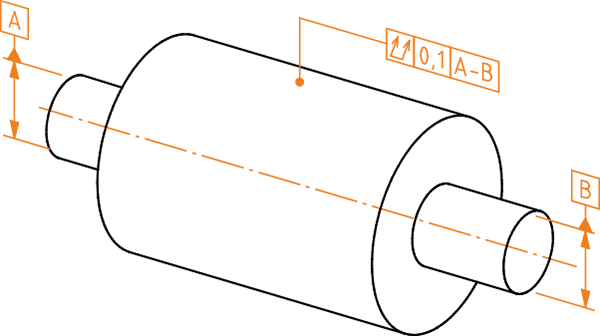
Definition of the tolerance zone
The tolerance zone is bounded by two coaxial cylinders whose radial separation is t and whose centerline coincides with the datum axis.
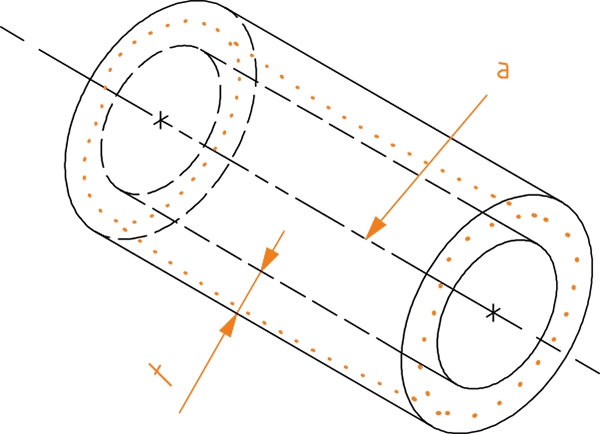
Importance in manufacturing
Total run-out is a particularly important tolerance when the balance and performance of the entire surface determine the usability of the part. If total run-out is not controlled, it can result in vibration, uneven wear, noise, and even failure of the entire mechanism.
Because total run-out combines several different form and location requirements, it can be tight and demanding from a manufacturing perspective. Excessively tight tolerances significantly increase costs, as achieving them requires precision machining and careful inspection, often with a coordinate measuring machine (CMM).
In the ISO 1101 standard, total run-out is defined as one of the key run-out tolerances. It helps ensure that rotating components remain high-quality and reliable throughout their service life.


