
Mastercam Dynamic Milling
Dynamic milling is a machining method jointly developed by tool manufacturers and CAM software developers. Dynamic machining methods were originally developed for roughing difficult-to-machine materials, such as hardened steels and heat-resistant superalloys, but they are also well suited to milling other materials. The method utilizes the tool’s entire cutting depth, allowing the tool to wear evenly along the full cutting length and improving tool life.
The basic principle of dynamic milling is a large axial depth of cut (ap) and a small radial depth of cut (ae) compared with conventional machining methods. Dynamic milling avoids cutting across the full width of the tool and straight-line movements whenever possible; material is instead removed using smooth toolpath movements.
Dynamic machining is generally always performed using climb milling, meaning that once a cut has been completed, the tool returns to the beginning of the next cut at a high feed rate (a so-called non-cutting feed). The approach and departure movements to and from the toolpath are always made along an arc (approximately 10% of Dc). In dynamic milling, the tool diameter (Dc) should not exceed 70% of the width of the area being machined. In dynamic high-speed milling, the stepover ae is generally approximately 5–20% of Dc, depending on the tool and the material being machined. When dynamically milling enclosed pocket shapes, the use of external coolant should be avoided because the fluid presses the chips down into the pocket, where they can interfere with the machining operation. Air cooling is therefore the recommended option during dynamic milling.
Dynamic facing normally uses the tool manufacturer’s recommended optimum cutting width (approximately 60–90% of Dc). Compared with conventional facing methods, such as unidirectional or zigzag facing, the advantage of dynamic facing is a smooth toolpath that follows the area being machined. In dynamic facing, the tool remains engaged with the material throughout the operation, and the cutting direction remains constant while the stepover is continuously maintained at the specified optimum value. Dynamic methods keep the chip flow and machine-tool load constant, which makes it possible to use higher cutting data.
Advantages and disadvantages of dynamic milling
Advantages:
- Higher cutting speed
- Higher feed per tooth
- Higher chip removal rate
- Shorter machining time
- Improved chip control
- Reduced heat generation
- Lower tooling costs
- Reliable machining process
- Only one cutting edge engages the material at a time, reducing vibration
- Lower power requirements compared with conventional machining methods
Disadvantages:
- Long NC code
- Machining programs are difficult to read without CAM software
- Manual editing of the NC code is impossible
- Memory required for the NC code in the machine tool control
- Older machine tool controls may be unable to read long NC code
Cutting tools and tool holders for dynamic milling
The most common cutting tools can be used for dynamic milling, but the greatest benefit is achieved by using long-edge solid-carbide end mills specifically designed for dynamic milling and equipped with multiple cutting edges and chipbreaker grooves. Examples include the Walter Tools MD133 series of end mills, available with 3xD, 4xD, and 5xD cutting lengths. In addition to the tool being used, the stepover in dynamic toolpaths is also affected by the machining depth, workpiece material, machine tool, machine tool taper, tool holder, and workholding method. To ensure a reliable machining process, always use the tool manufacturer’s cutting-data calculators, which take the above factors into account. One example of such a calculator is Walter GPS.
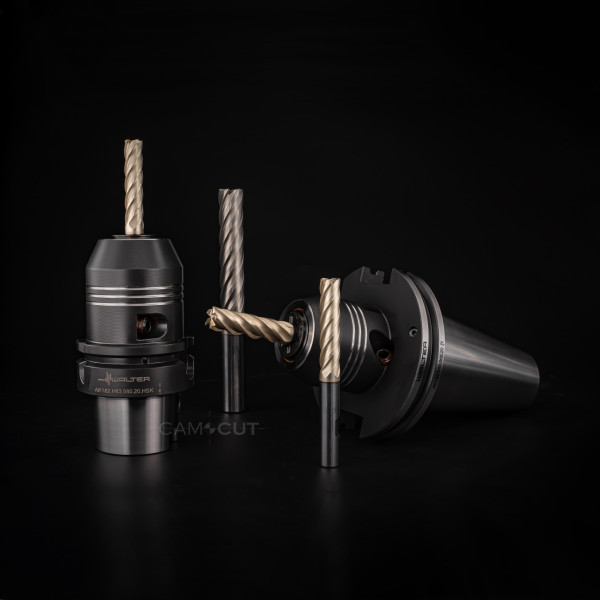
The importance of the correct tool holder in dynamic milling should not be underestimated. Because tools designed for dynamic milling are often more expensive than conventional end mills, tool clamping also has a significant impact on the cost-effectiveness of the process. The recommended tool holder for dynamic milling is a hydraulic precision chuck, such as the Walter Tools AK182. A hydraulic precision chuck provides a secure and stable tool connection while also maintaining high runout accuracy. A secondary option for dynamic milling tools is Weldon clamping, which also provides a secure connection but not the same level of runout accuracy. This affects both tool life and workpiece surface finish. When using shrink-fit holders or other slim tool holders, it is often not possible to use the tool’s maximum cutting data. ER collet chucks should be avoided because increasing machining forces can cause the tool to pull out of these holders. If necessary, an ER collet designed for dynamic milling can also be used, allowing the tool to be locked in place to prevent pullout.


