
News
10 Things to Consider When Purchasing Cutting Tools

Cutting tools are the cornerstone of machine shop production, and their selection has a direct impact on productivity, quality, and costs.
Cutting tools are the cornerstone of machine shop production, and their selection directly impacts productivity, quality, and costs. The right tool choice isn't determined solely by purchase price, but by a bigger picture that emphasizes lifespan, reliability, productivity, delivery assurance, and the support offered by the supplier.
Even the best race car can't perform well with poor tires – in the same way, even the finest machine tools can't reach their full potential without tools suited to the specific requirements of the process. Tool acquisition is an overall process where every choice affects the outcome.
Tool technology evolves rapidly. New materials, coatings, and geometries enable longer tool life and higher machining values. At the same time, tool vending machines, online stores, tool selection programs, and digital databases make tool information accessible to the user at every stage of production.
This article covers ten perspectives to help you make productive and long-term decisions when investing in cutting tools.
1. Know Your Machining Methods and Objectives
 Tool acquisition starts with understanding your own production and objectives. It's important to identify which materials are machined, what types of parts are produced, and what batch sizes are being made. Cutting tools shouldn't be generic compromises, but should support your own style of production – whether it's for single parts or mass production.
Understanding the machining methods and the requirements of the workpiece helps in selecting the right geometries, coatings, and clamping solutions. Different materials, such as stainless steel, cast iron, and aluminum, behave differently during machining, so the tools must be chosen accordingly.
It's wise to consider future developments already at the acquisition stage. If your aim is to move toward multi-axis machining, unattended production, or implement automated storage that handles tool warehousing, inventory monitoring, and automatic replenishment, choose a supplier whose systems support these goals.
2. A Unified Tool System and a Broad Selection
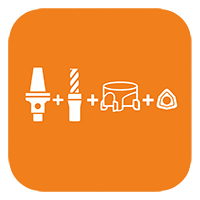 A wide tool offering speaks to the manufacturer’s expertise and long-term product development. When solutions for milling, turning, drilling, and threading are available from the same supplier, the acquisition process is simpler and managing the entire solution becomes easier. You can order different types of tools that work together as compatible parts of the same system – from tool holders and chucks to tool bodies and inserts.
A centralized supplier reduces administrative work and costs. When products are ordered at once from the same place, you avoid extra fees for small deliveries and reduce the handling of multiple orders, shipments, and invoices. Information management is also easier: tool 3D models and machining values can be found from a single source, so tools can be quickly put to use in CAM programming and production.
A wide selection also means solutions for different materials and machining environments. This helps standardize processes and ensures that the same tool family can be used across different machines and assemblies. When tools, support, and technical applications come from the same partner, developing your production is long-term and predictable.
3. Tool Performance and Lifecycle Costs
 The value of a cutting tool is not determined by its purchase price, but by the total return over its lifetime. A high-quality tool may cost more upfront, but a longer lifespan, higher machining values, and less downtime make it a more cost-effective solution overall.
In a machine shop, costs often arise more from tool runtime, change frequency, and process stability than from the purchase price itself. A reliable tool reduces scrapping and interruptions, so when making purchases, it's worth comparing performance and tool life variability in different materials as well as price.
Optimizing the tool for the machining process – such as coolant direction, chip formation, and coating suitability – can significantly improve productivity. Tool value calculators offered by manufacturers help you assess this in advance. When decisions are based on lifecycle costs instead of single purchase price, you achieve better results both economically and in your processes.
4. Innovation and Continuous Product Development
 The performance of a cutting tool is also affected by the manufacturer's commitment to research and development. New solutions are created through materials research, testing, and collaboration with machine tool and CAM software manufacturers.
The ability to innovate is reflected in coating technologies, chip control, and tool structures designed for longer tool life, higher machining values, and more stable processes. Many solutions originate from customer needs, and new products are actively tested in real production conditions to make sure they meet practical requirements.
Continuous product development demonstrates a manufacturer’s long-term approach and ability to adapt to changing needs. When new products and improvements are released regularly, your shop has access to up-to-date technology that supports the capabilities of new machine tools and the latest toolpaths in CAM software.
5. Regrinding Service and Tool Lifecycle Management
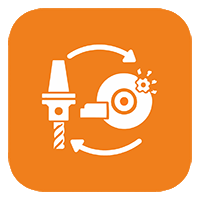 Maintaining the tool is often the quickest and most cost-effective way to extend its life. Regular regrinding preserves the cutting geometry and provides nearly new results at a much lower cost than buying a new tool. When regrinding is performed using the manufacturer’s methods, the tool is restored to its original geometry and recoated, so it can be used with the same cutting values as a new tool.
A systematic cycle for maintained tools reduces storage needs and acquisition costs without impacting production quality. At the same time, your company reduces material waste and environmental impact – a sustainable approach supports both economic and ecological goals.
The reliability and quick turnaround of regrinding services are important for production continuity. When maintenance is part of the manufacturer’s or a local partner’s service network, tools return quickly to use and their lifecycle is easy to track. In this way, regrinding service is an essential part of a well-managed and efficient production process.
6. Digital Tool Solutions to Support Production
 Digitalization has introduced new tools for planning and optimization in the machining industry. Manufacturers’ digital solutions support proper tool selection, the determination of machining values, and tool data management. Selection programs, mobile apps, and cloud-based databases bring up-to-date information directly to programmers and machinists without having to search separate catalogs.
Increasingly, systems are based on the ISO 13399 standard, which enables consistent storage and transfer of tool data. Standardized data ensures compatibility of tools from different manufacturers with CAM systems and other software, so 3D models, geometries, and cutting values move seamlessly from design to production.
Digital solutions are complemented by advanced machining calculators. In addition to the tool and material, they take into account the features of the machine tool, clamping, and key process parameters. Beyond value recommendations, calculators provide information on cycle times, tool life, required power and torque, and the chip flow, directly reflecting process productivity.
7. Modern Online Stores Are Much More Than Order Platforms
 Modern online stores have evolved from order sites into service platforms that support users from product selection through to programming. User-friendly interfaces, filters, and AI-based search features allow fast comparison, and real-time inventory levels immediately show what’s available. Customer-specific pricing and visible order history make purchasing easier and reduce the need for separate quotations.
High-quality online stores also provide CAM-ready 3D models and files, so tools can be used directly in programming. This reduces errors and speeds up production setup.
When the online store is integrated with the supplier’s support services and customer accounts, it truly functions as a production-supporting tool. It’s no longer just an ordering portal, but part of a modern, well-managed acquisition process.
8. Availability and Delivery Reliability
 Delivery reliability is a key factor in tool purchasing. Production stoppages are expensive, so the necessary tools must be available at the right time and with reasonable delivery costs. Before buying, check delivery times and conditions, and how inventory levels are updated in the online store.
Products shipped from within the EU typically arrive faster and without customs delays. Tools ordered from outside the EU may require customs clearance, which can add days to the delivery time and increase costs.
In today’s global environment, it’s also important to consider geopolitical risks. A supplier with multiple manufacturing and warehouse locations and a strong logistics network in Europe can respond quickly to market changes and ensure deliveries even in exceptional circumstances.
9. Technical Support and Application Expertise
 High-quality technical support is an essential part of the tool supplier’s service. Even the best products won’t deliver full value without proper commissioning and process-specific optimization. A supplier’s expertise is evident in their understanding of machining methods, machine characteristics, and how different materials behave in machining.
Modern tool suppliers also understand the role of CAM software in the manufacturing process. A knowledgeable partner can assist users in programming and demonstrate tool suitability directly within the CAM environment, speeding up process development, improving quality, and reducing errors before production begins.
Experienced experts help not only with specific problems but with the development of the entire process – for example, setting machining values, standardizing tools, and comparing machining strategies. When support is quickly available in your local language, issues can be resolved before they have a chance to halt production.
10. A Reliable Partner Is More Than Just a Supplier
 Procuring tools is not just about buying products, but about long-term collaboration. A reliable partner understands your overall production and supports its development – not just by supplying tools, but by ensuring their efficient use and continuous improvement.
When your partner knows your machine inventory, machining methods, and production goals, they're able to offer solutions that increase productivity and process reliability. Collaboration is based on open interaction and knowledge sharing in both directions.
A reliable partner is there for you even when things change, whether it’s new machines, methods, or materials. This kind of partnership brings continuity, reduces risks, and helps to ensure your investments remain competitive into the future.
Productive Production Starts With the Right Tools
Buying cutting tools isn’t just purchasing consumables; it’s an investment in production quality, efficiency, and competitiveness. The right tool solutions improve productivity, extend service life, and support the long-term growth of your company.
When making acquisitions, it’s important to consider the whole picture: tool performance, delivery reliability, digital compatibility, and the technical support offered by the supplier. Together, these factors define how well your processes are managed and what savings can be achieved over the entire lifecycle.
If you need help selecting tool solutions, the experts at Camcut are happy to assist with mapping your needs and planning the implementation.
[contact_member,name="",id=3,details=Name-Telephone-MobilePhone-Email-MemberPhoto]
[contact_member,name="",id=128,details=Name-Telephone-MobilePhone-Email-MemberPhoto]


