
Geometric Tolerances: Form — Cylindricity
Cylindricity is a form tolerance that defines how closely a cylindrical surface conforms to an ideal cylinder. In practice, it combines requirements for both circularity and straightness: every cross-section must be round, while the entire cylinder axis must remain straight. Cylindricity is one of the fundamental form tolerances specified in ISO 1101.
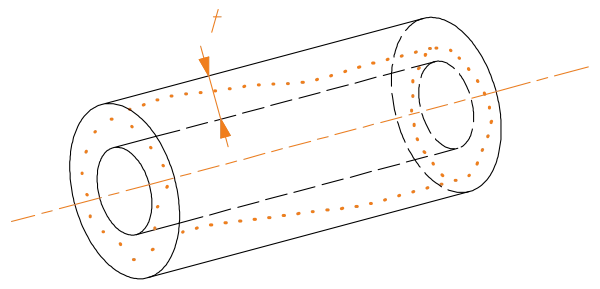
The tolerance zone is formed between two coaxial cylindrical surfaces whose radial separation equals the tolerance value specified on the drawing. All points on the actual cylindrical surface must lie within this zone.
Applications
- Shafts: ensuring that the shaft is uniformly round and straight along its entire length, which is important for proper fit with bearings, bushings, and seals.
- Cylindrical holes: the hole must retain a cylindrical shape so that pins or bolts, for example, fit reliably.
- Rotating machine components: consistent cylindricity reduces vibration, noise, and uneven wear.
Notation and interpretation
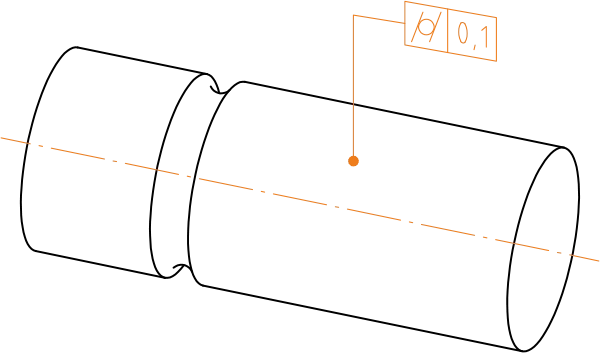
The (actual) cylindrical surface must lie between two coaxial cylindrical surfaces whose radial separation is 0.1.
Definition of the tolerance zone
The tolerance zone is bounded by two coaxial cylindrical surfaces whose radial separation is t.
Importance in manufacturing
Cylindricity is particularly critical in precision engineering. If a shaft or hole is not sufficiently cylindrical, components may be loaded unevenly, leading to accelerated wear, seal leakage, or even machinery failure. On the other hand, excessively tight requirements increase manufacturing costs because controlling the tolerance requires precision machining and measurements using equipment such as a coordinate measuring machine (CMM).
Cylindricity tolerance provides a balance between functional quality and manufacturing costs—ensuring sufficient accuracy for reliable component performance without unnecessary overengineering.


