
Geometric Tolerances Runout Runout
Run-out is a tolerance that defines how much the actual shape and position of a rotating feature may deviate from ideal rotational motion. Run-out controls both form and positional errors when the part is evaluated during rotation relative to a datum. It is particularly important for rotating components, where even a small inaccuracy can cause imbalance, vibration, or excessive wear.
Run-out is one of the fundamental geometrical tolerances defined in ISO 1101. It acts as a kind of “combined tolerance” because it incorporates several aspects of form and positional accuracy in a single requirement.
Applications
- Shafts and bearing surfaces: ensuring that the shaft rotates smoothly without excessive wobble.
- Holes and sleeves: preventing irregularities during rotation that could cause a joint to loosen or wear.
- Rotating components: such as brake discs, gears, and crankshafts, where even a small amount of run-out can significantly affect performance.
Indication and interpretation
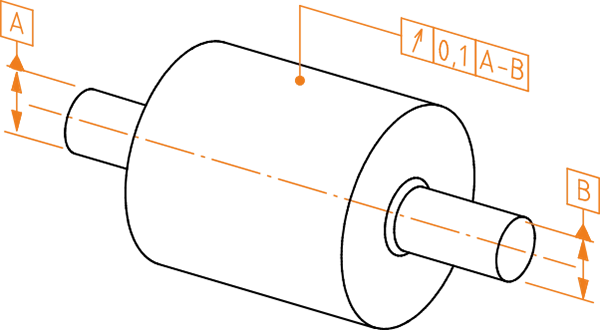
In every plane perpendicular to the common datum axis A–B, the measured (actual) line must lie between two concentric circles in the same plane, with a difference in radius of 0.1.
Definition of the tolerance zone
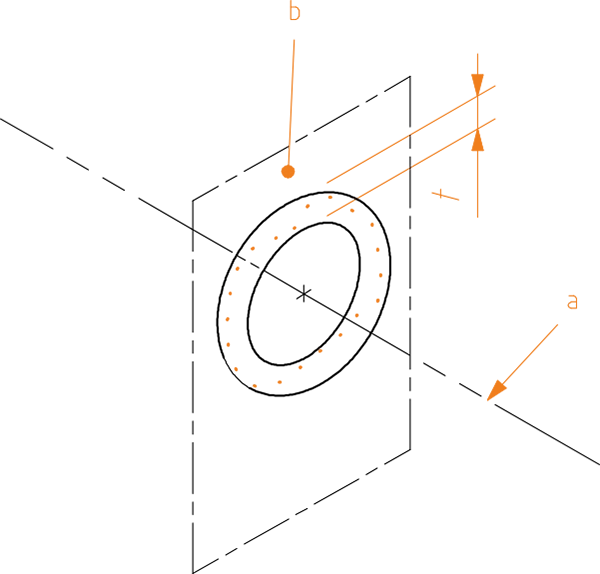
In every cross-sectional plane perpendicular to the datum axis, the tolerance zone is bounded by two concentric circles with a difference in radius of t, whose centers lie on the datum axis.
Significance in manufacturing
Run-out is a critical tolerance because it directly affects a part’s functionality and service life. Excessive run-out often leads to noise, vibration, seal leakage, and accelerated wear. For this reason, it is commonly applied to machine components that rotate or that must be accurately aligned around an axis.
At the same time, it is important to remember that measuring and controlling run-out requires specialized equipment, such as run-out gauges or coordinate-measuring machines (CMMs). An unnecessarily tight requirement increases costs, so the tolerance should be set only as tightly as required for proper function.
The run-out tolerance specified in ISO 1101 provides a clear and internationally consistent way to ensure that rotating parts operate smoothly and reliably.


